Sustainable building Wood is eco & logical
Our wood is sustainable and ecological. Under ideal conditions, all that is needed for this building material to grow is a little space, sun, rain - and time. As it grows, a tree also stores carbon from the air and is something of a small climate fire brigade. Anyone who builds with wood and pays attention to regional, environmentally friendly processing of the building material is doing something good for themselves and for nature. Products from best wood SCHNEIDER are even certified by the Institut für Baubiologie Rosenheim and PEFC.
The IBR seal of approval from the Institut für Baubiologie Rosenheim identifies building materials and products that have not only been tested for possible negative effects on people and the environment, but also take into account aspects such as production, processing and recycling. PEFC is the world's largest independent organisation for ensuring and improving sustainable forest management in compliance with ecological, social and economic standards.
Independently audited. Transparently certified.
The Institut für Baubiologie Rosenheim GmbH (IBR, Institute for Biologically Sound Construction) puts its seal of approval ‘Examined and Recommended by the Institute for Biologically Sound Construction in Rosenheim (Germany)’ on healthy and environmentally sustainable consumer construction products.

PEFC is a transparent and independent system for ensuring sustainable forest management and thus a global "forest MOT". Forest certification according to PEFC standards is based on very strict guidelines for the sustainable management of forests. This management is controlled by competent and independent organisations.

An EPD (Environmental Product Declaration) presents the life cycle of a building product as well as information relevant to building physics and in general. The Environmental Product Declaration is drawn up in accordance with the DIN EN 15804 standard and thus ensures a uniform assessment and comparability of EPDs.
Produkte mit diesem Siegel wurden von natureplus geprüft und erfüllen die Anforderungen durch das Qualitätssiegel Nachhaltiges Gebäude (QNG) zur Schadstoffvermeidung in Baumaterialien.
www.qng.info



Material guarantee deposited with the Central Association of the German Roofing Trade. Only the professional processing of flawless materials guarantees true customer satisfaction. This is why the ZVDH has developed the material guarantees together with renowned partners in the roofing industry. We offer the guild companies protection in the event of material complaints, in that we, as the manufacturer, have deposited a comprehensive guarantee for our products.

QNG tested - of course! Quality seal for sustainable buildings (QNG): Solutions from best wood SCHNEIDER are certified
Through our partner IBR (Institut für Baubiologie Rosenheim), which independently tests our products and thus guarantees the ecological quality of our products, all certified solutions from best wood SCHNEIDER are also "QNG tested". This means that we can guarantee that our solutions fulfil the requirements of the Quality Seal for Sustainable Buildings (QNG) - and thus make sustainable construction with funding possible.
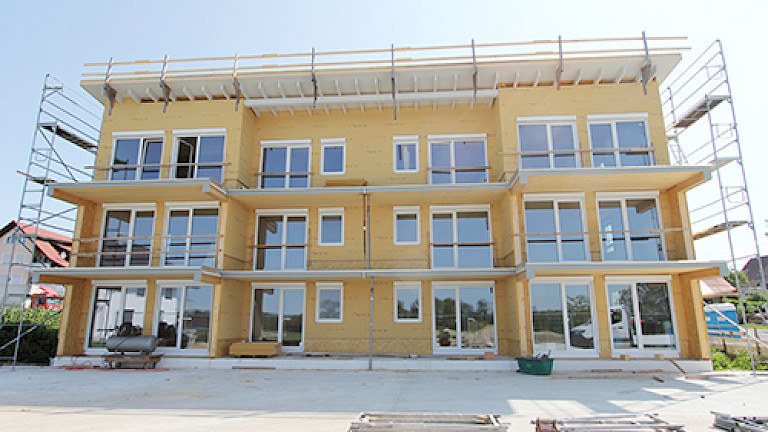
Wood already offers many advantages in the construction phase: It can be processed precisely and quickly, often requires less space than other building structures and, as a renewable raw material, easily fulfils all environmental requirements. Thanks to the wide variety of species, the right type of wood with the right material properties can always be used for the specific purpose. The service life of timber constructions is in no way inferior to other building materials - and should a building have to give way one day, the wood it contains can be returned to the raw material cycle.
This makes wood the ideal material if a building is to be sustainable. In addition to the construction and maintenance costs, it is necessary to take an overall ecological view over the entire service life of the building project. Wood scores points here over the entire life cycle - from the extraction of raw materials and the reduction of overall energy requirements through to the service life and possible subsequent use.